Dominican Republic
Samaná, Los Haitises National Park and El Limón
The crossing to the Dominican Republic
Two days before our departure from the island of La Blanquilla, we received visitors on board. Rob and Jo, a Canadian couple with their three teenagers, asked us about our destination port. When they heard Dominican Republic, they were thrilled. They asked shyly if we would mind if they joined us with their boat, of course only for this crossing. Of course we allowed them to do so. Now we got to hear their story, which was unimaginable to us. They are actually a family of seven from Oona River on Porcher Island in British Columbia, Canada. This is a small village with only about 30 families. One day they decided to go on a sailing trip. Sailing experience zero and of course there is no sailboat available either. Through the internet they found a small yacht advertised for sale. 5,000.- US $ is cheap and the yacht is already in Trinidad. So the boat is bought immediately, unseen. The two oldest children did not want to join the trip and stayed home, the rest flew to Trinidad. For the three children there was no school adjustment, as they had previously done their lessons at home via distance learning. Arriving in Trinidad, the first major disillusionment came. The boat did not look bad, but its basic condition was. For a full 18 months they had all toiled away, replaced parts, pulled new cables, mended the sails, replaced the engine, etc. etc. Tens of thousands of francs had to be put additionally into the boat. In the meantime, the family has also grown by one cat. The fact that this sweet kitty already had three kittens in her belly was unfortunately noticed too late. Five people and four cats was therefore now the new crew.
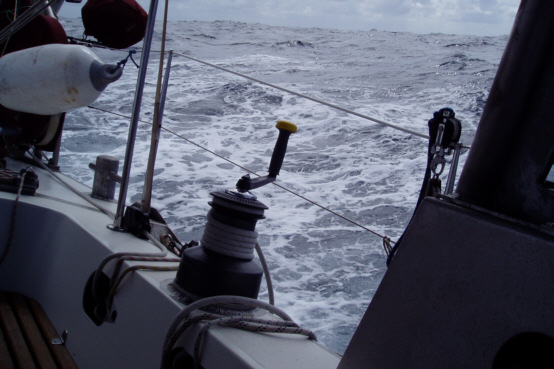
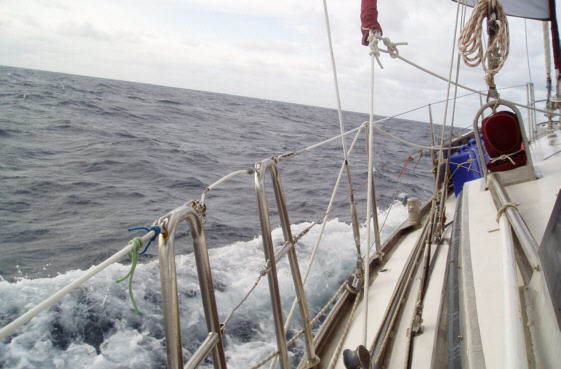
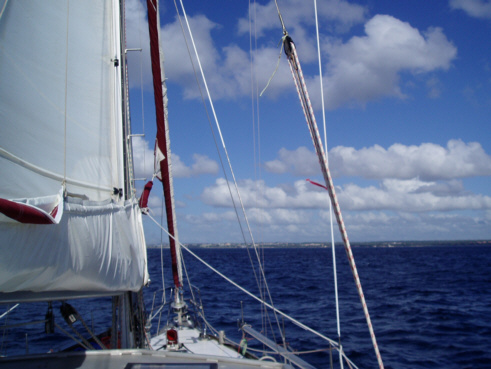
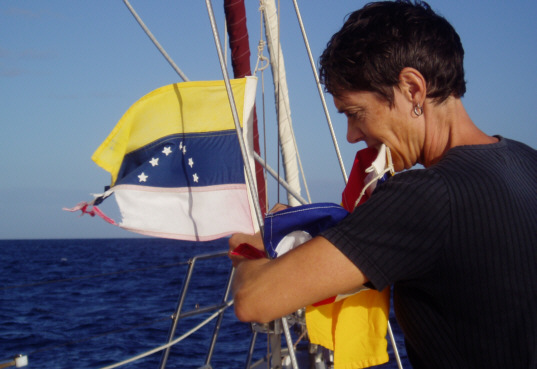
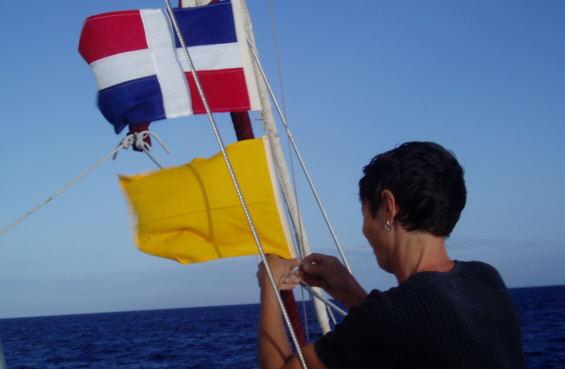
Then finally, the big moment. The first trip with their own boat became reality. The route led from Trinidad via Los Testigos to Isla Margarita. Of the five people on board, three constantly remained down below in the horizontal position. The barf bucket was used industriously and the first joy of sailing life was greatly dampened. The same spectacle on the next, short trip to La Blanquilla. Now the 4-day trip to the Dominican Republic was coming up and everyone was already feeling slightly uneasy. So we agreed, "at 7:00 in the morning weigh anchor and set sail. All three boats will have the radio set to channel 74 and we will try to always adjust the speed to the slowest."
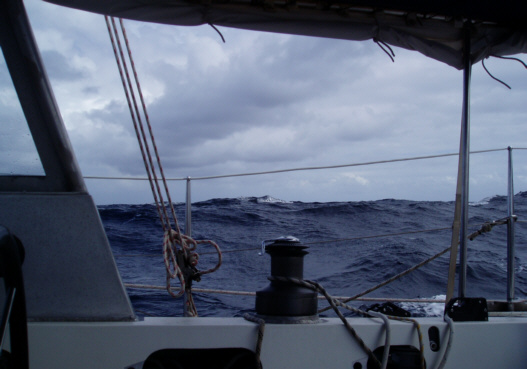
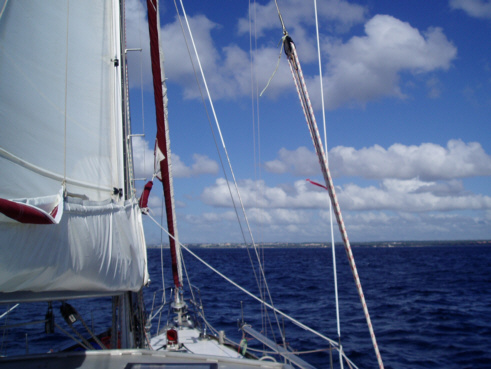
With a nice 20 knots of wind from aft and a 2.50-meter swell from the same direction we started. We made good progress and everything seemed to be going just fine. Around noon then a radio message from Rob: "Sorry, I am turning around and heading back towards La Blanquilla. On board actually everything is O.K., except that I am still the only one not hanging over the rail. Thanks for your help and have a good onward journey. We now have to reconsider our plans!" Said, turned and away they were.
I don't think I have mentioned yet what size boat the Canadians have. Yvonne and I live alone on our 14-meter boat. We don't feel like there is too much space there. Rob, Jo, three half-grown children and the four cats live on a boat 10.50 meters long. This results in a living space of approximately less than 18 m2, incl. kitchen, toilet, sleeping quarters, engine room, storage spaces, etc. To better visualize this size, or rather crampedness, please go now into the smallest room of your apartment.
Clearing customs in La Romana and then quickly onwards to Bayahibe
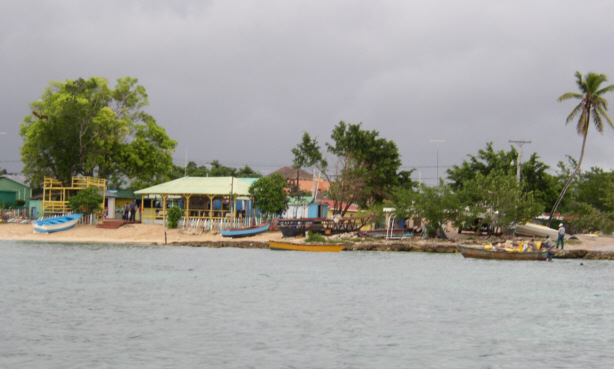
On the morning of December 7, we reached the southern coast of the Dominican Republic. Unfortunately, we could not find any sailing guides or other documents important for sailors for this side of the island. All existing nautical literature refers only to the north and northeast of the island. The guides available on the market are all specifically tailored to anxious Americans. That means they describe, in at least 300 pages, the route down from Florida to the Caribbean. The reverse route, however, the one up from the Caribbean to the USA, is briefly mentioned in at most two scant pages. Apparently, once US sailors are down in the Caribbean, they no longer return north.
Shortly before noon, we arrived in La Romana. Carefully we steered our
into the river mouth. According to our chart, we now had to keep far to the right here and leave a marked buoy strictly to port. In reality, however, the position of this buoy has today been moved so far to the right that it can now only be passed on the left side. Here the water depth should actually be only just under 3 meters, but our depth sounder always showed over 12 meters. Suddenly we saw a large, new quay for smaller cruise ships. That was the solution to the riddle. The river mouth was recently dredged to a water depth of over 12 meters in order to participate in the cruise ship business.
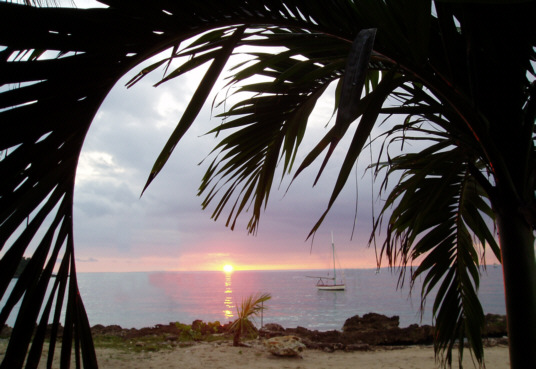
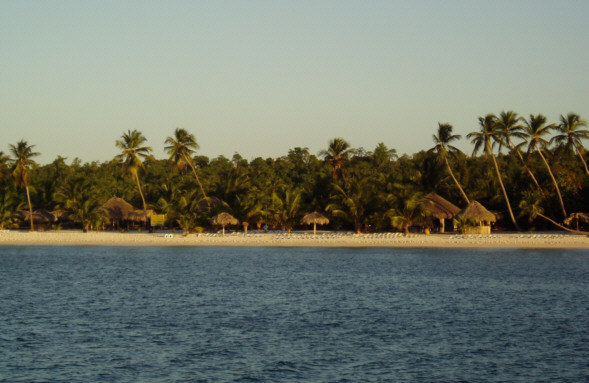
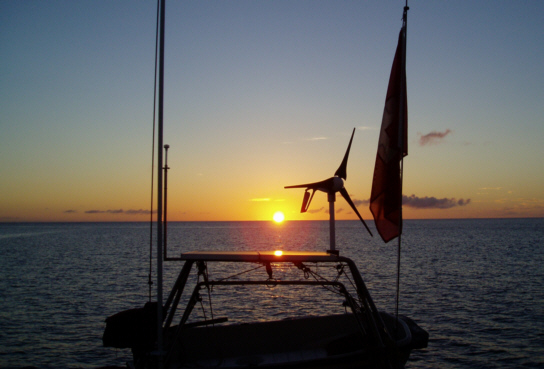
After the quick and unproblematic clearance, we had to leave the small harbor in the river mouth as soon as possible, because they were expecting, logically enough, a cruise ship.
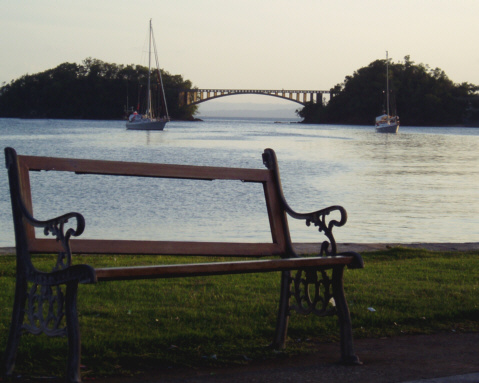
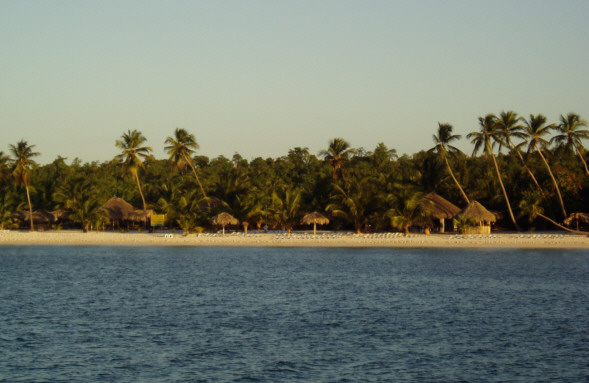
So we made our way, following the commander's advice, to the nearby village of Bayahibe. According to our tourist guide, this was supposed to be a sleepy little fishing village. Exactly the right thing for us, then. Once we arrived there, it really looked just as dreamy. There were only a few fishing boats, but also quite a few empty buoys in the water. The two
's were just finishing their anchoring maneuvers when suddenly an armada of fast motorboats shot from the south toward the calm bay. Around twenty boats and at least another 8 large tourist catamarans came shooting toward us. All fully loaded with yelling day tourists and entertained by very loud music. Suddenly the idyll was over. The small bay filled more and more with these noisy tourist boats. Just as we were seriously considering sailing away, the ghost vanished and quiet returned just as suddenly. All tourists had been brought ashore, loaded into the waiting coaches, and carted off to the distant hotels. The resort, which was very skillfully integrated into the landscape in front of the village, did not disturb, and thus Bayahibe and we had our peace again... until the next day when the same spectacle took place all over again.
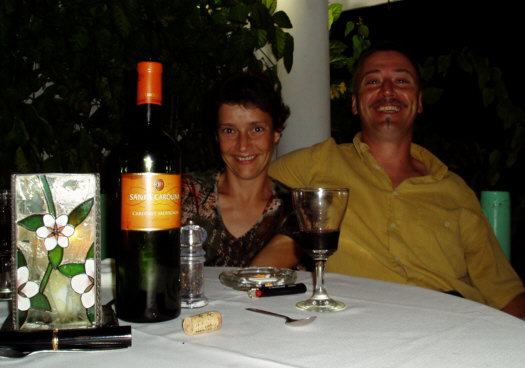
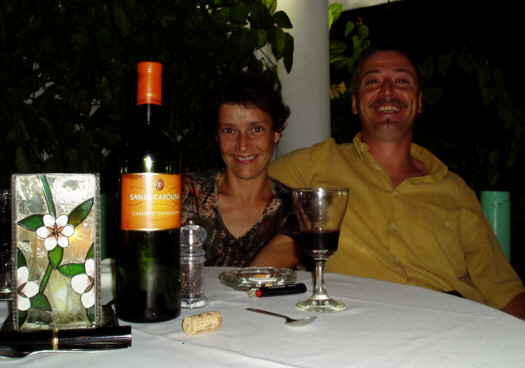
In mid-December Caroline, Yvonne's sister, came to visit for a month with her partner Pascale on the
. They suffered the same fate as every visitor to an overseas blue water yacht. Their luggage had to be stuffed full of spare parts urgently needed by us from Europe. The fine Lindor balls for Yvonne and the Ovomaltine for me rounded off this heavy transport culinarily.
Off to Santa Barbara de Samana and something about "Ciguatera"
The Encarta Encyclopedia 2003 describes the weather in the Dominican Republic, among other things, as follows: The climate of the Dominican Republic is, corresponding to its location, marginal tropical with the alternation between a winter dry season and a summer rainy season. Rain falls predominantly between May and October.
We ourselves had been here on the island since early December, but we felt absolutely nothing of the announced dry season. Until now there had been several rain showers every day, and sometimes even very heavy ones. Fortunately, at least the temperatures were comfortably high, so we and our clothes always dried relatively quickly... until the next downpour.
In the standard tourist guide we found the information that from mid-December very many humpback whales are supposed to come into the Bay of Samana. They would come down from the north to give birth to their calves here in these warmer waters and also to mate. Based on this information, we left the south of the island and sailed up into the large Bay of Samana.
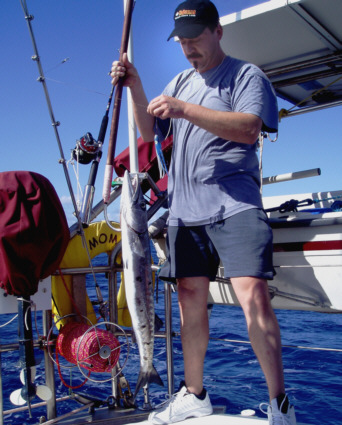
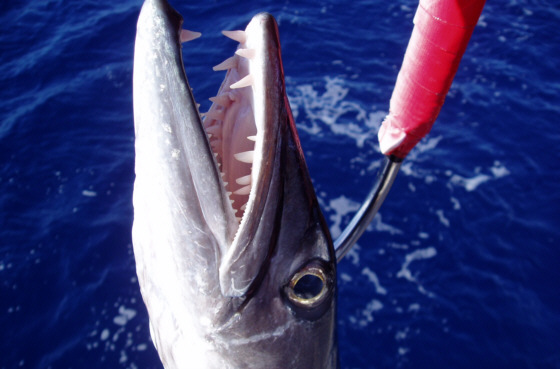
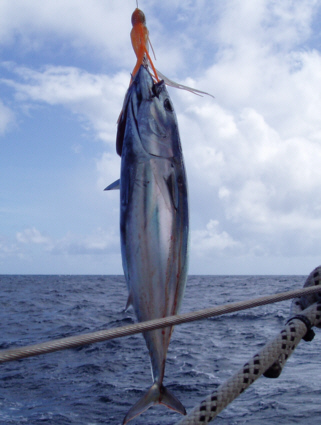
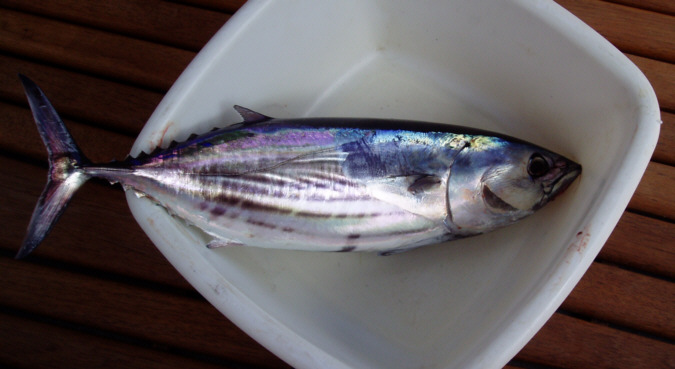
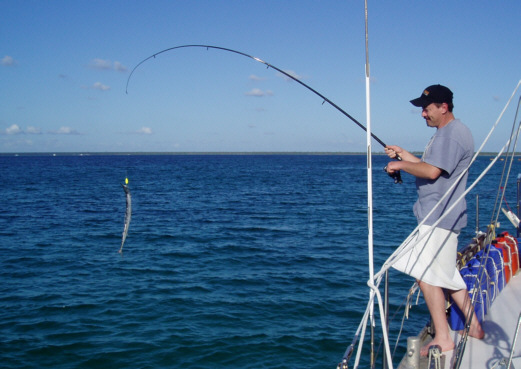
Hoping for a delicious meal, we immediately cast the fishing line, of course. The first bite did not take long either. A medium-sized barracuda (about 80 cm long) was on the line. The barracuda is an always hungry predator and unfortunately dangerous for us. Not only because of its very large and sharp teeth, no, because of ciguatera. This is a life-threatening poison that originates from a small type of algae. These algae live in the tropical coral reefs and are eaten by small fish. These small fish, in turn, are eaten by larger ones and these, logically, in turn by even larger ones. Thus, the toxin becomes more and more concentrated and the barracuda, at the end of this food chain, then has a dose in it that is lethal to humans. Ciguatoxin is heat-stable and therefore cannot be destroyed by boiling, roasting, or grilling. In tropical countries, the rule of thumb therefore is: The barracuda must be shorter than an arm's length.
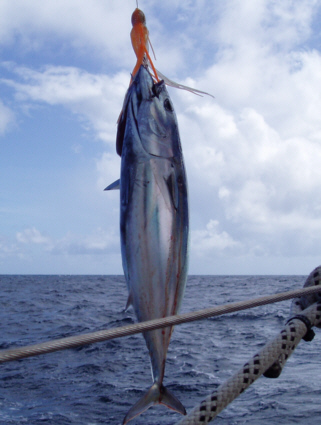
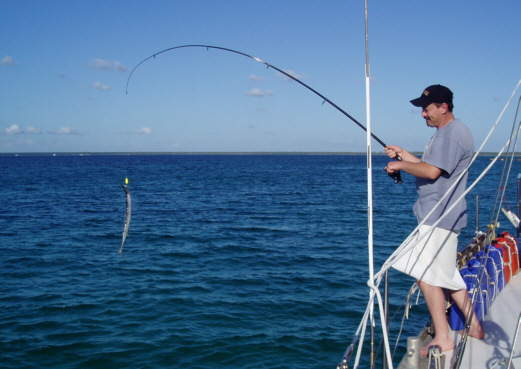
With regret, but following reason, we released the first catch again and put the fishing line back into the water. Not even 15 minutes later, another bite. This time the fishing rod bent even further and anticipation for a mahimahi, or even a delicious wahoo, grew. Our disappointment was huge when the fish, after minutes of fighting, was finally at the boat. Another barracuda. This time even one with a length of over 1 m. This time we, or rather the fish, had bad luck because the hook was already so deep in its throat that we could no longer get it out. This big fish also had to go overboard again because it certainly had a multiple of the ciguatoxin dose still tolerable for us. Now we waited about three hours before our bait, which we had since exchanged for a blue one, went back into the water. Unfortunately, the same thing repeated itself once more. Again a barracuda (this time about 75 cm) on the line. Annoyed, we released this one too and put our fishing gear away. For dinner we just had grilled chicken again.
Los Haitises National Park
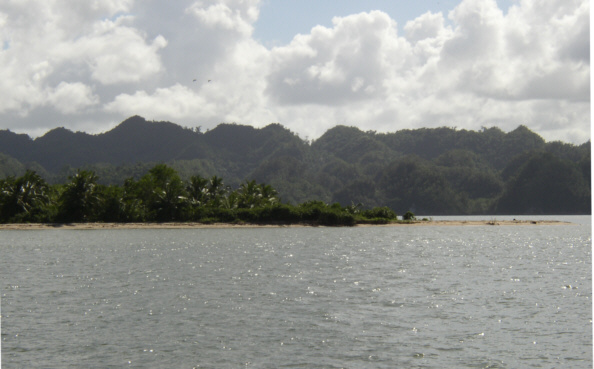
This large national park, located in the south of Samana Bay, was our next stop. To be allowed to anchor there, however, it is essential to obtain a small permit beforehand. This would not cost anything, the commander said when clearing in.
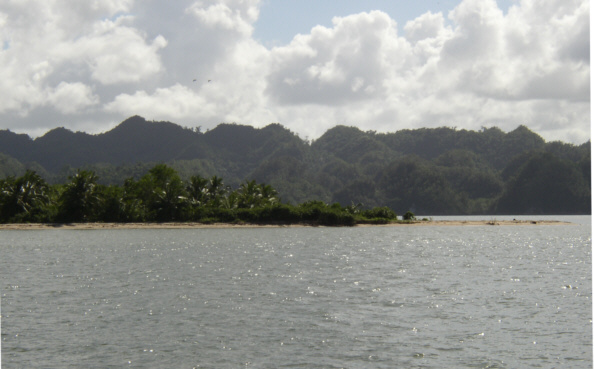
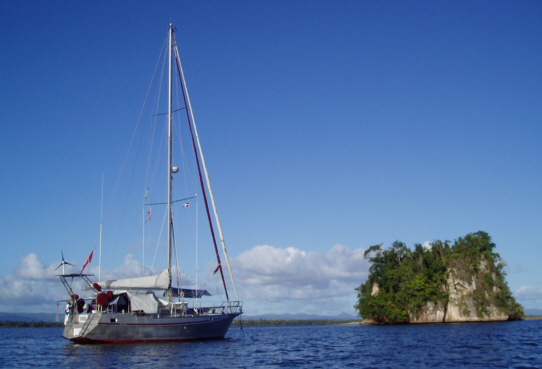
Towards the middle of the afternoon on December 23, we visited the commander's office to get this very permit. "Oh disculpe, no permit can be issued today. The woman who operates the typewriter is unfortunately not here at the moment, but please come back tomorrow." The next day we were back in the same office shortly before 8. Once again the woman was not present, but today a fat, dark man was suddenly apparently able to handle the typewriter keys as well. He sat down spread-legged behind the machine and began ...... to wait. To my insolent question of why he wasn't starting to write the form, another answered, "today is a holiday and filling it out therefore costs 200 pesos extra." There went my peace of mind. I asked, politely but very firmly, to speak to the commander immediately. Of course he had just, coincidentally a minute ago, gone out. Well then, not an unsolvable problem. "Samana is not big, please go get him. I will wait here." Not 5 minutes later, the commander stood before me and tried to worm his way out. When he realized that there was no donation-happy American, but a stubborn goat from Switzerland standing in front of him, he personally signed the form and handed it to me with a friendly smile. Inwardly I was slightly proud of having defied this corrupt office. I pulled out my wallet and, to the surprise of those present, placed 200 pesos on the table. This episode was well worth the scant 10 CHF to me, as a tip or even as a Christmas present to the office.
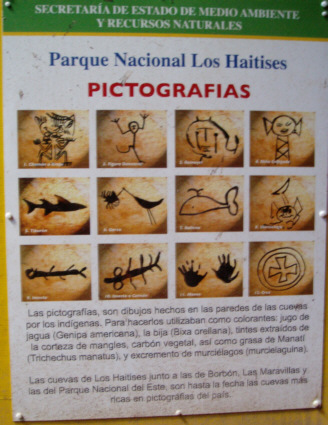
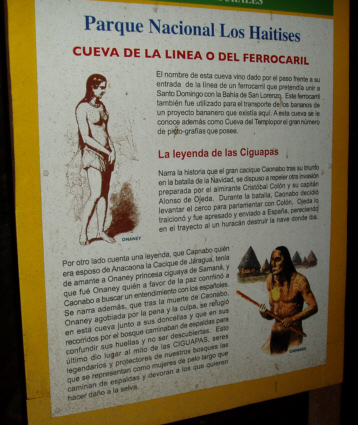
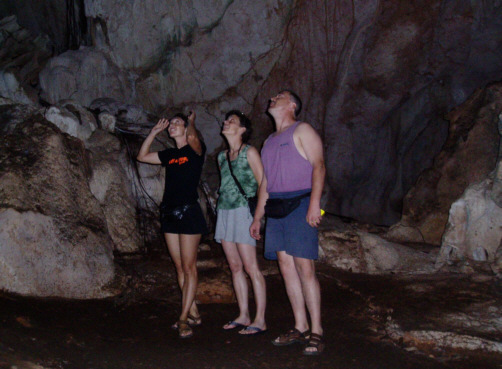
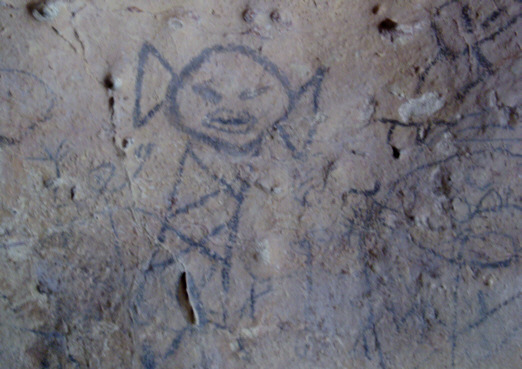
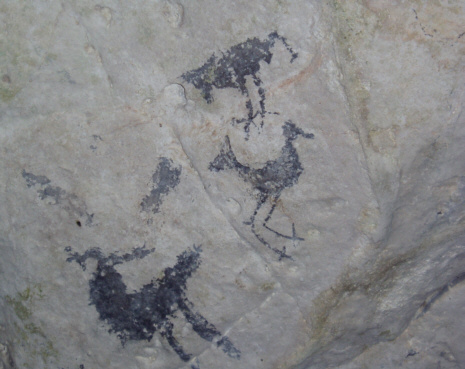
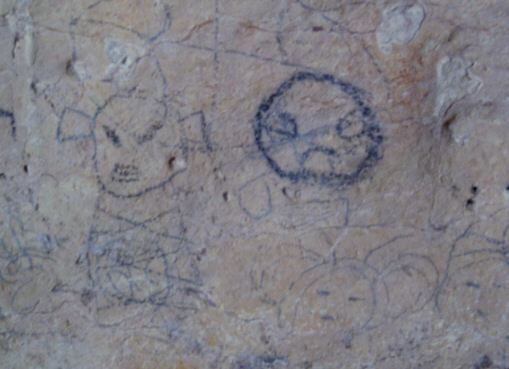
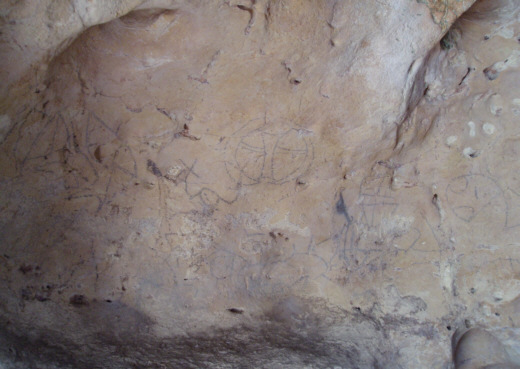
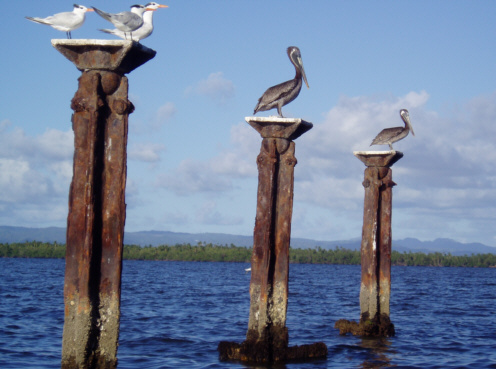
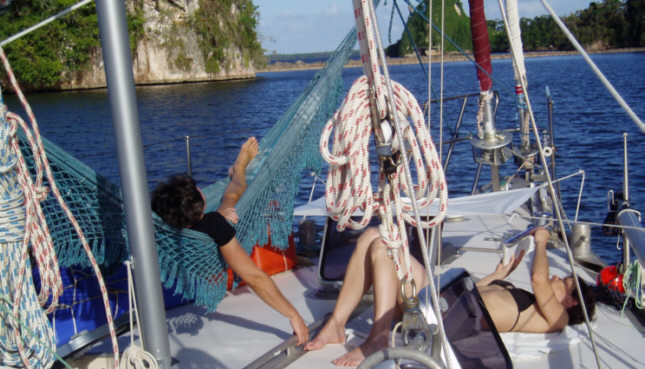
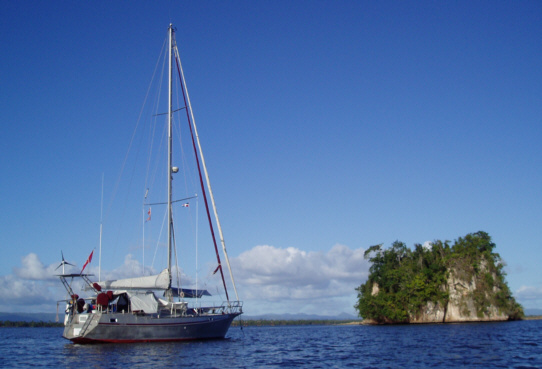
Arriving in the national park, we were personally welcomed by the resident sergeant and his companion. Which was actually not all that surprising, as the two MOMO's were once again the only sailboats on site. Only a few speedboats, filled with hotel tourists, sometimes came over from Samana or Sanchez. However, the stay of these boats never lasted longer than half an hour, after which peaceful calm returned. On this stretch of coast there were various caves that had been inhabited by the indigenous people. Many of their cave paintings have been preserved. However, I struggled with the motifs and symbols that can still be seen today. As an absolute layperson when it comes to Native Americans, they reminded me much more of the bedroom walls of my two sons, Simon and Dani.
Trip to the "El Limon" waterfall
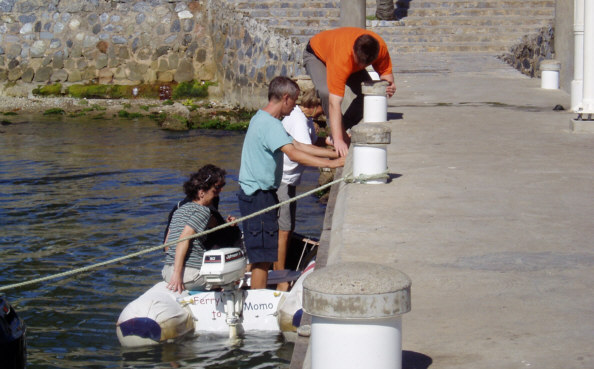
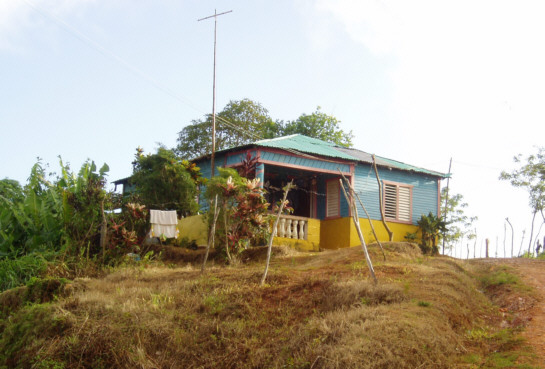
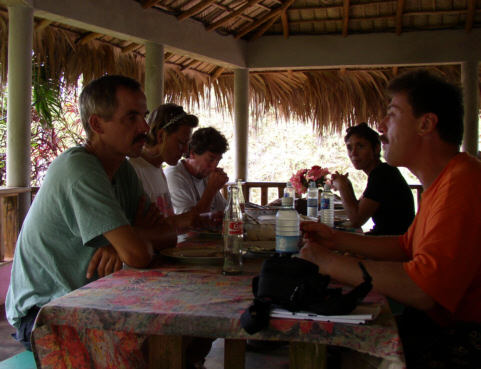
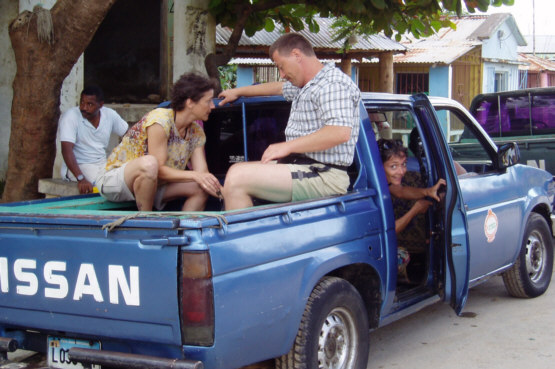
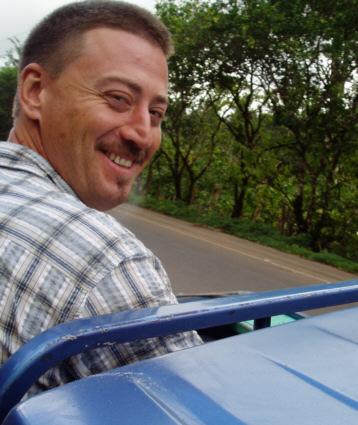
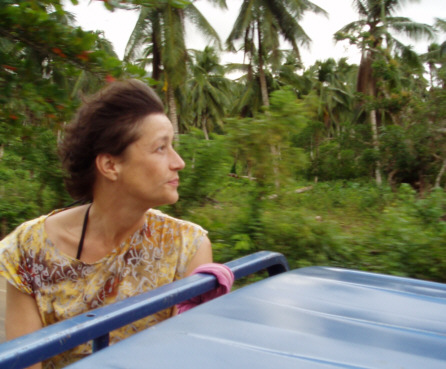
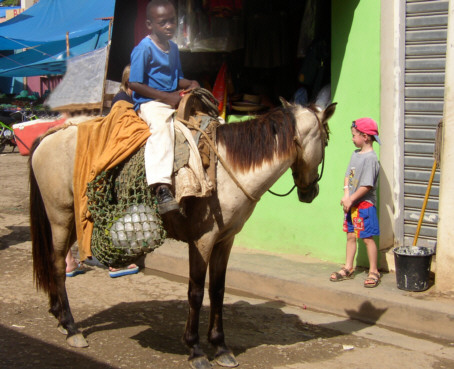
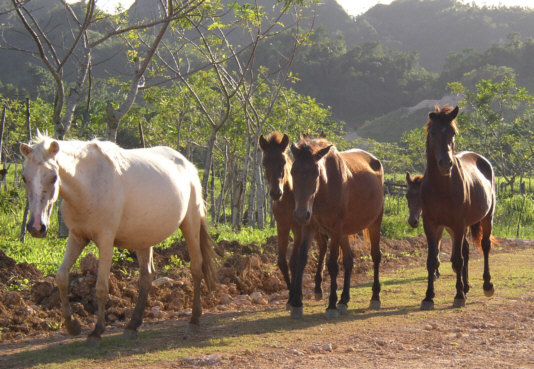
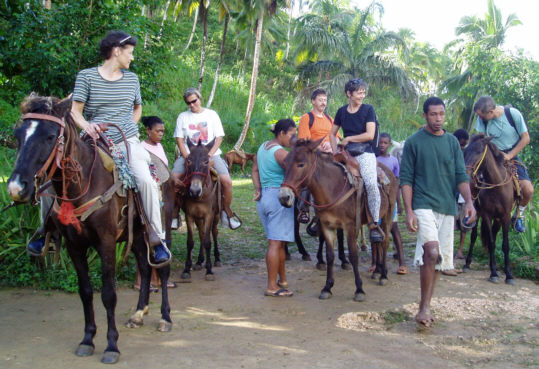
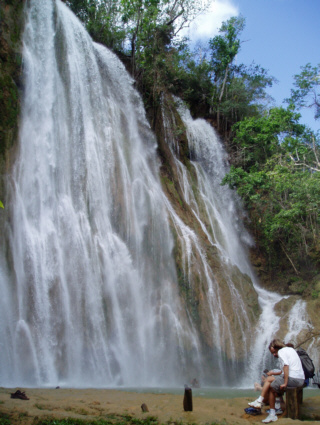
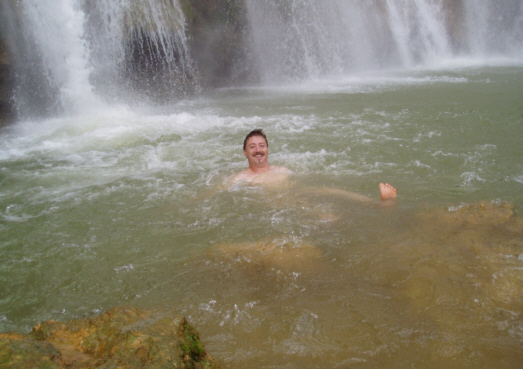
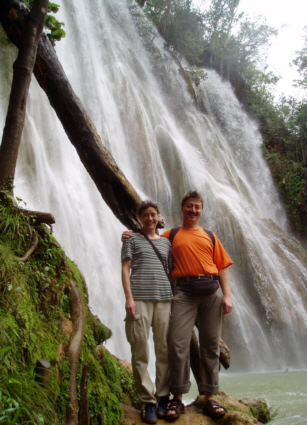
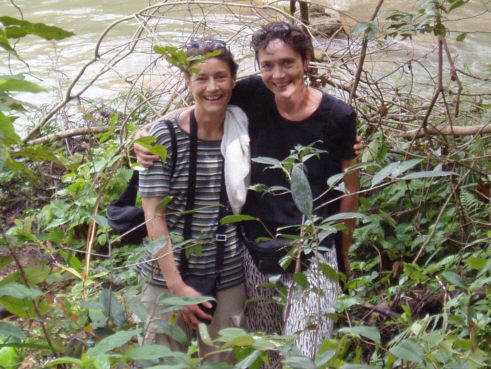
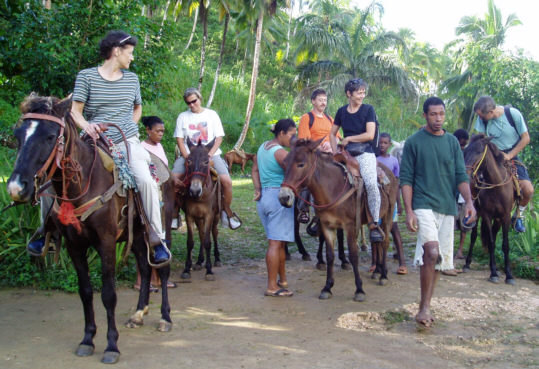
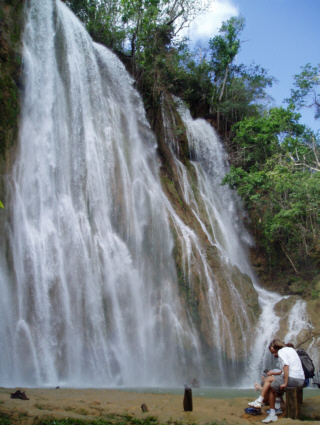
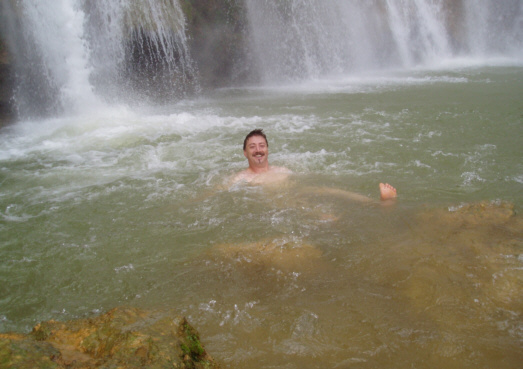
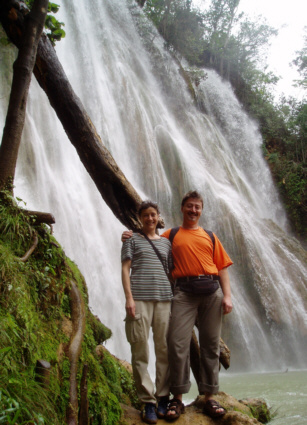
El Limon, the best-known waterfall in the north of the island, was said to be a must, according to everyone. From my experience in the West Indies, however, I was slightly skeptical about what such Caribbean waterfalls actually have to offer. Previously, I had always seen only small trickles that did not really deserve the name waterfall. Full of expectation, we took the guagua towards El Limon. A guagua here was a type of shared taxi and by far the cheapest way to get somewhere. Not only because of the cramped conditions in the always overcrowded cars, we immediately made contact with the locals every time. Sometimes, however, the cars only had small cabins and some of the people had to sit outside in the back on the loading bed. This time was no exception. Pascal visibly enjoyed feeling the wind rushing around his ears, while Caroline held on rather frantically to the roof structure. The last stretch to the waterfall was covered on the backs of leisurely walking horses. Then finally, the waterfall. It thundered down over a cliff edge about 35 meters high, and with a great deal of water at that. At the bottom there was a small lake that invited you to swim. So I take back my negative words immediately. There really is a waterfall in the Caribbean.
Santa Barbara and its vibrant market
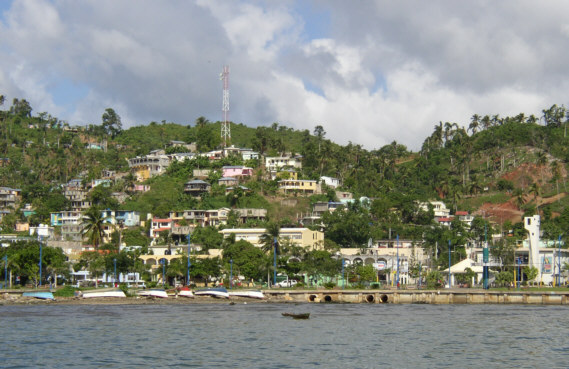
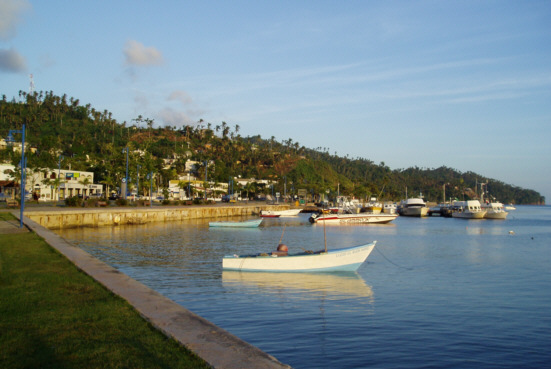
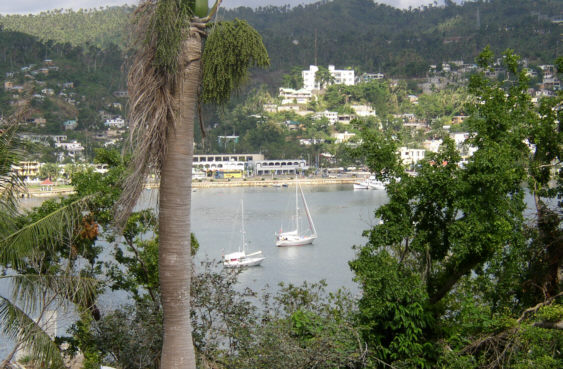
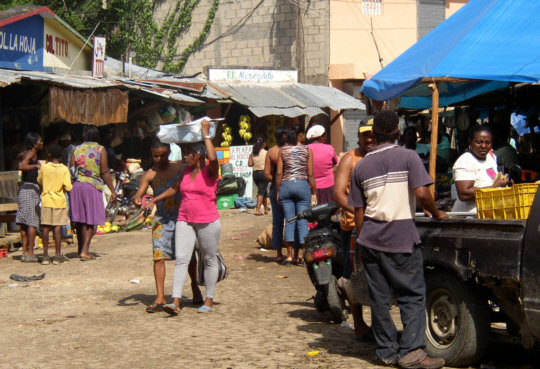
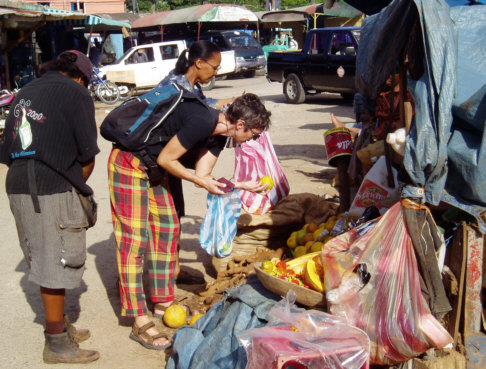
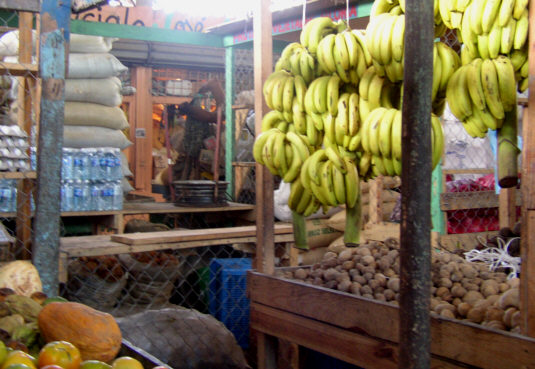
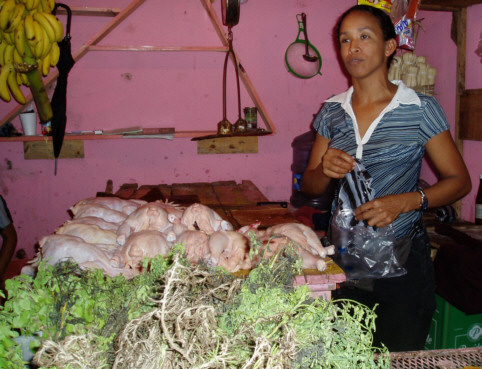
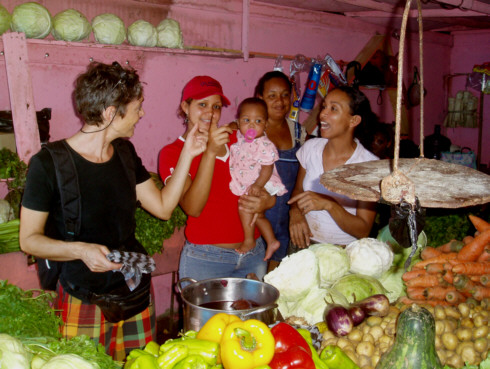
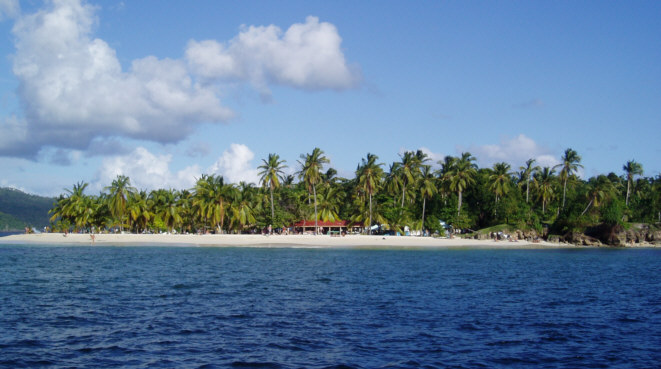
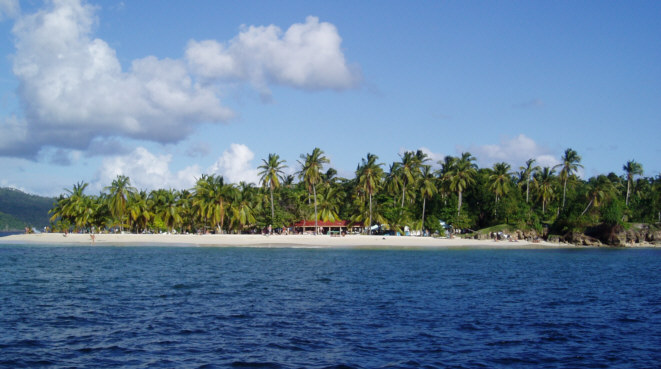
Santa Barbara is a small town on the north side of the bay. Without visible industry and without the large tourist hotels, it looks rather sleepy here. Tourists actually only come here for the day to immediately head out to the small bathing island of Cayo Leventado. That is supposedly where the tropical commercial for "Bacardi" was filmed.
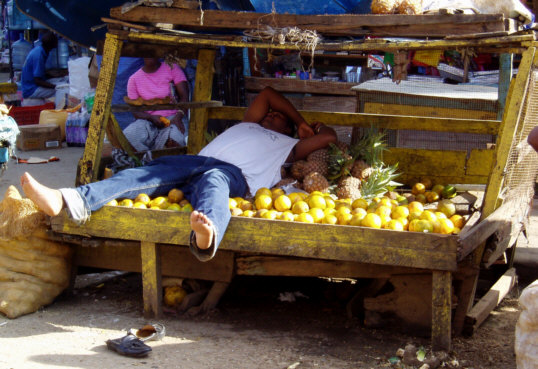
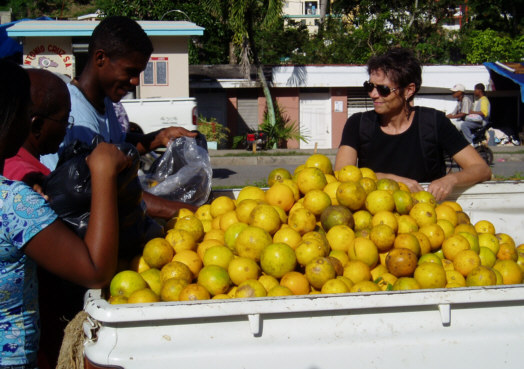
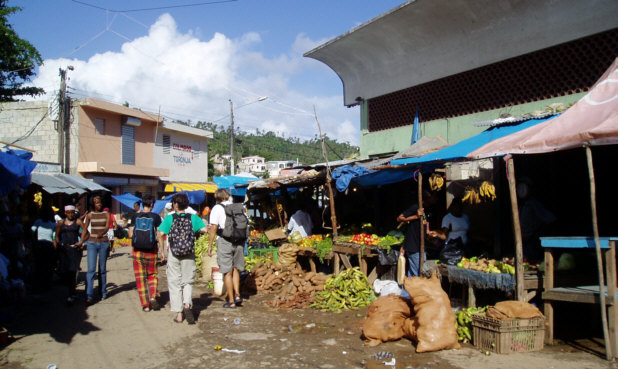
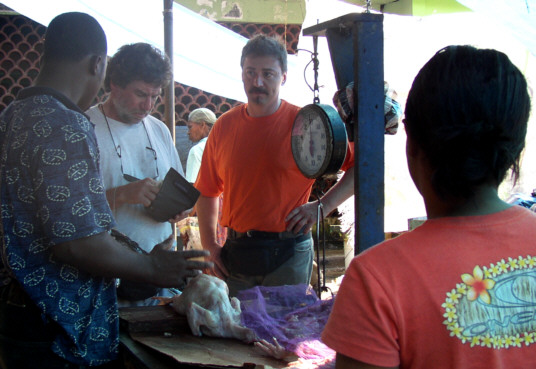
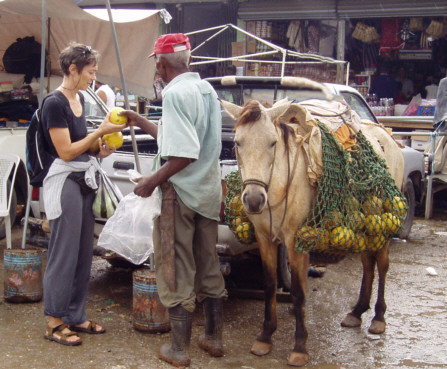
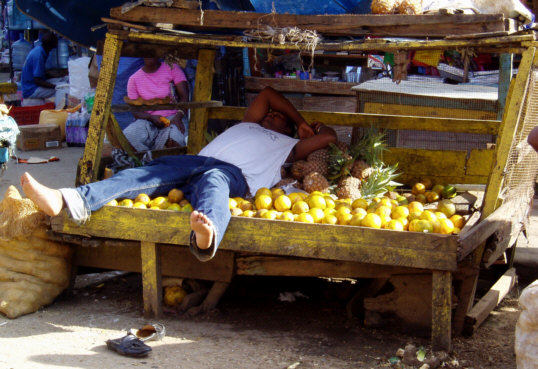
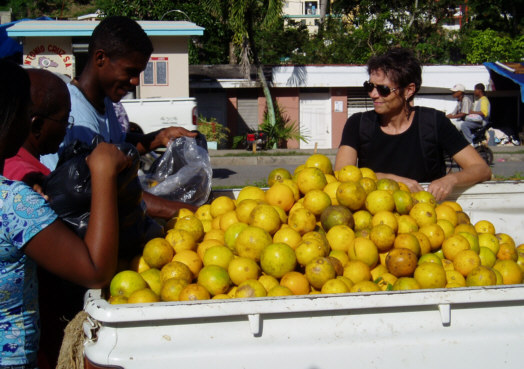
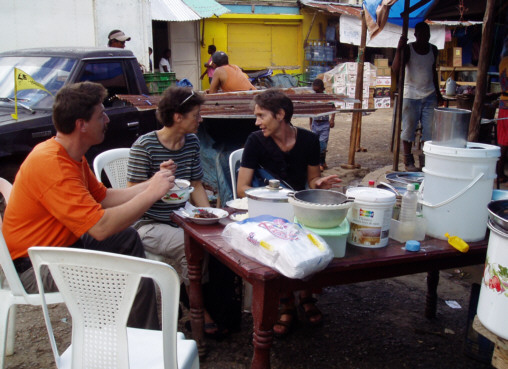
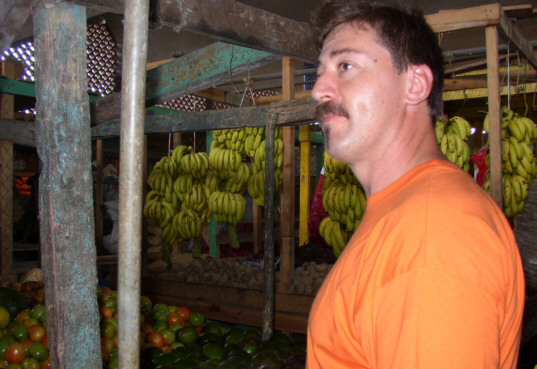
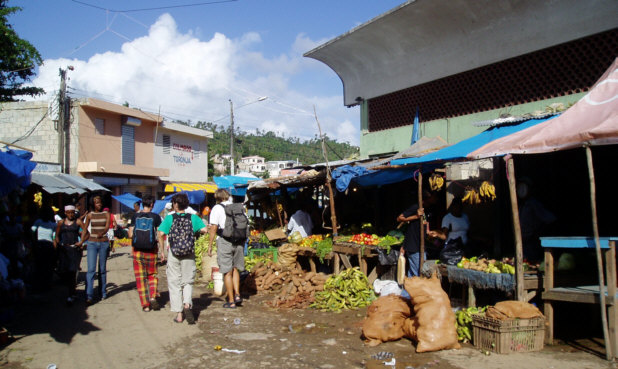
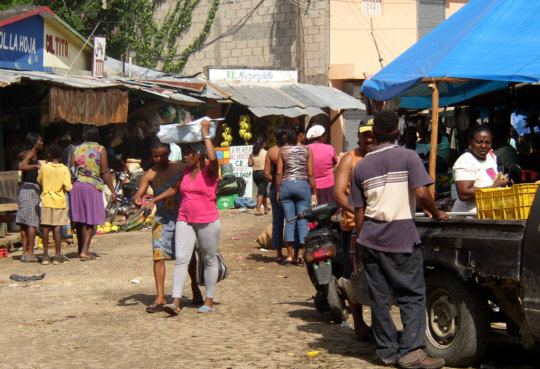
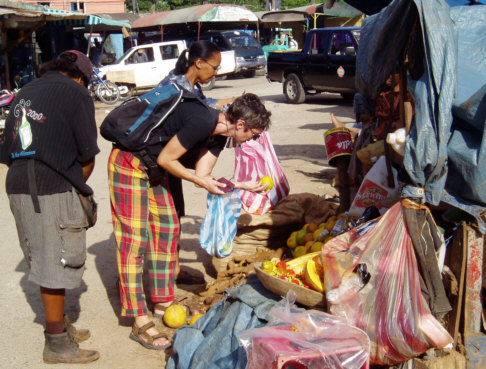
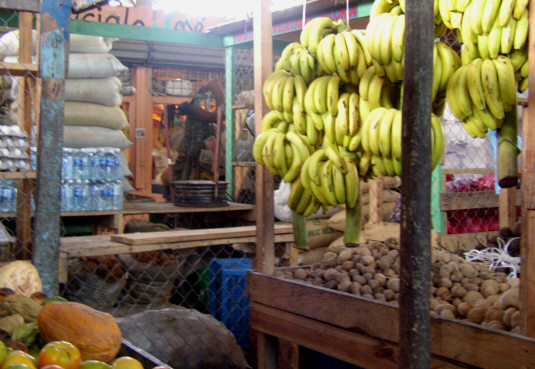
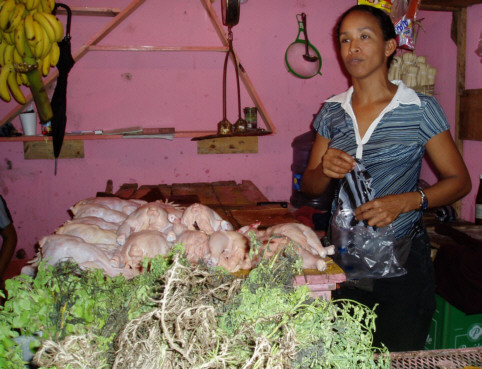
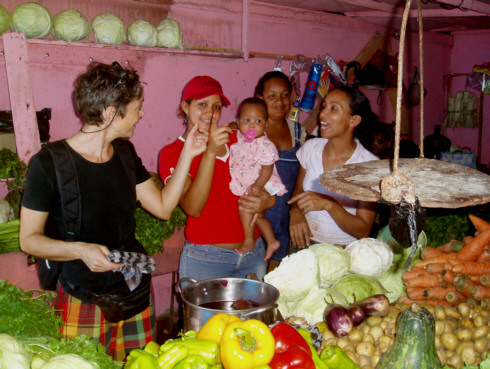
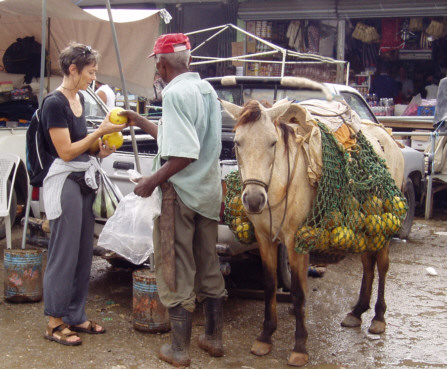
For me, the best thing about Santa Barbara is the name and the simple market. But this market is truly unique and bursting with life. I could linger there for hours just watching the hustle and bustle. The oranges were brought in by small trucks and partly sold right off the flatbed. An old man came with his donkey and tried to sell some grapefruits. Over there, half a beef carcass was being sawn up on a wooden board, and here the fish were at least still in a plastic container on ice. On another table, slaughtered chickens were ready, and underneath them, the living replenishment was still cackling. There were mountains of papayas, bananas, pineapples, and over here a pile of fresh vegetables. A truly colorful hustle and bustle, accompanied by loud merengue music. Merengue, as is well known, is the musical style of the Dominican Republic. To my ear, however, it was somewhat monotonous, and therefore practically everything always sounded the same. With our MOMO, we were anchored about 200 meters away from the shore. Always in the late afternoon, the various small bars and snack bars started turning up their loudspeakers. We had the impression that the fewer people there were in the bar, the louder the music got. The mix of at least ten sources of music that we sometimes had to endure was at times close to unbearable.
The Crossing to the Dominican Republic
Two days before our departure from the island of La Blanquilla, we had visitors on board. Rob and Jo, a Canadian couple with their three teenagers, asked us about our destination port. When they heard Dominican Republic, they were thrilled. They asked shyly if we would mind if they joined us with their boat, of course only for this crossing. Of course we allowed them to do so. Now we got to hear their story, which was unimaginable to us. They are actually a family of 7 and come from Porcher Island in British Columbia, Canada. That is a small village with only about 30 families. One day they decided to go on a sailing trip. Zero sailing experience and of course no sailboat. Via the internet, they found a small yacht advertised for sale. 5000.- US $ is cheap and the yacht is already in Trinidad. So the boat was bought immediately, unseen. The two oldest children did not want to take part in the trip and stayed home, the rest flew to Trinidad. For the three children, there was no change in schooling, as they had previously completed their lessons at home via distance learning. Arriving in Trinidad, the first major disillusionment came. The boat did not look bad, but its basic condition was. For a full 18 months, they all worked hard, replaced parts, pulled new cables, mended the sails, replaced the engine, etc. etc. Tens of thousands of francs had to be invested additionally in the boat. The family has also grown by one cat in the meantime. Unfortunately, it was noticed too late that this cute kitty already had three kittens in her belly. Five people and four cats were now the new crew.
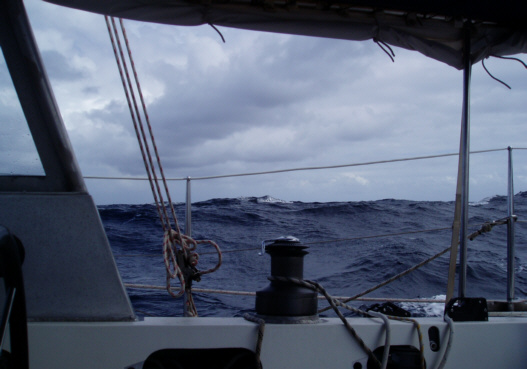
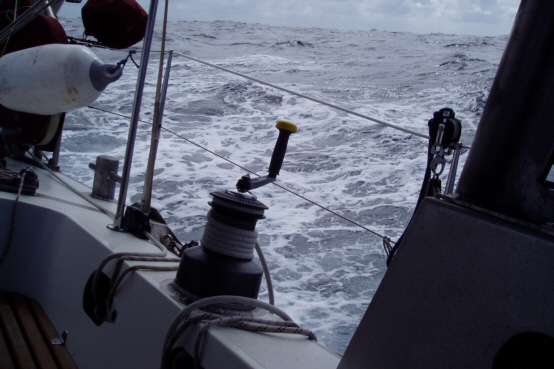
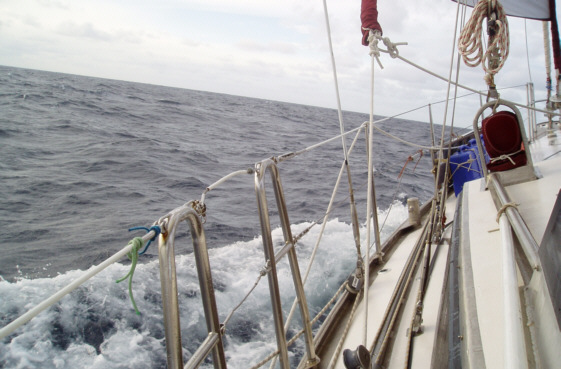
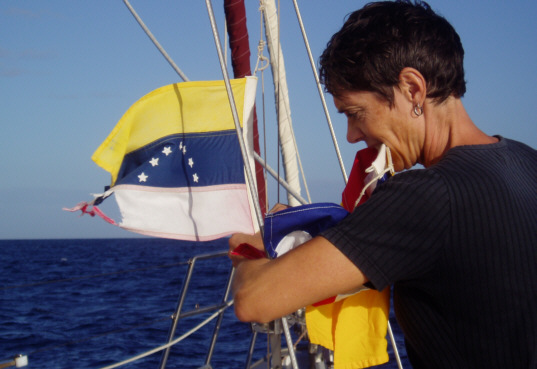
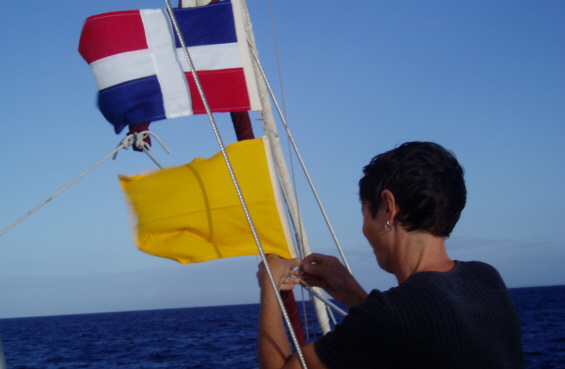
Then finally, the big moment. The first trip with their own boat became a reality. The route led from Trinidad via Los Testigos to Isla Margarita. Of the five people on board, three stayed down horizontally the whole time. The puke bucket was used busily and the initial joy of the sailing life was very much dampened. The same spectacle at the next, short trip to La Blanquilla. Now the 4-day trip to the Dom. Rep. was coming up and everyone was feeling slightly uneasy already. So we agreed, "at 7:00 in the morning weigh anchor and set sail. All three boats will have the radio set to channel 74 and we will try to always adjust the speed to the slowest."
With a nice 20 knots of wind from aft and a 2.50 m swell from the same direction we started. We made good progress and everything seemed to go fine. Around noon then a radio message from Rob: "Sorry, I am turning around and heading back towards La Blanquilla. On board actually everything is O.K., except that I am still the only one who is not hanging over the railing. Thanks for your help and have a good onward journey. We now have to rethink!" Said, turned and away they were.
I haven't said yet, I believe, what size boat the Canadians own. Yvonne and I live alone on our 14-meter boat. We don't feel like there is too much space. Rob, Jo, three half-grown children and the four cats live on a 10.50 meter long boat. This results in a living space of roughly less than 18 m2, incl. kitchen, toilet, sleeping quarters, engine room, storage spaces, etc. To better imagine this size, or rather crampedness, please go now into the smallest room of your apartment.
Checking in in La Romana and then quickly onwards to Bayahibe
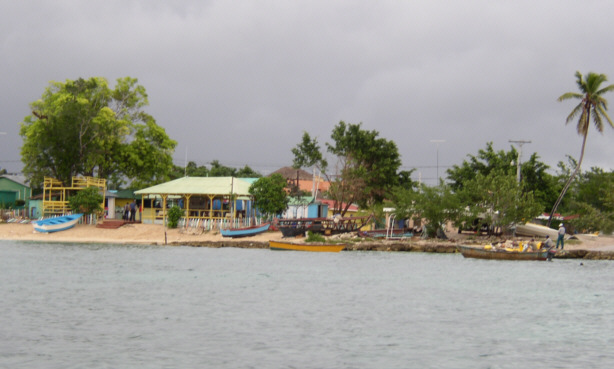
On the morning of December 7, we reached the southern coast of the Dominican Republic. Unfortunately, we could not find any sailing guides or other documents important for sailors for this side of the island. All existing nautical literature refers only to the north and northeast of the island. The guides available on the market are all specifically tailored to anxious Americans. This means they describe, on at least 300 pages, the route from Florida down into the Caribbean. The reverse route, however, the one from the Caribbean back up to the USA, is briefly mentioned in at most two scant pages. Apparently, US sailors, once they are down in the Caribbean, do not return north anymore.
Shortly before noon, we arrived in La Romana. Cautiously, we steered our
into the river mouth. According to our chart, we now had to keep far to the right here and leave a marked buoy strictly to port. In reality, however, the position of this buoy has today been shifted so far to the right that it can only be passed on the left side. Here, the water depth should actually be a scant 3 meters, but our depth sounder always showed over 12 meters. Now we suddenly saw a large, new quay for smaller cruise ships. That was the solution to the mystery. The river mouth was only recently dredged to a water depth of over 12 meters in order to participate in the cruise ship business.
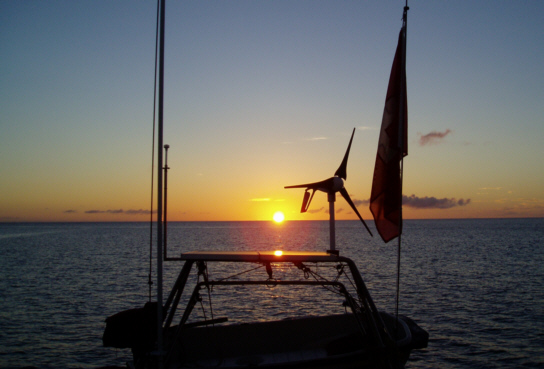
After the quick and problem-free clearance, we had to leave the small harbor in the river mouth as soon as possible, because they were expecting a cruise ship, which is only logical.
So we moved, following the commander's advice, to the nearby village of Bayahibe. According to our tourist guide, this was supposed to be a sleepy little fishing village. Exactly what we needed. Once there, it really looked just as dreamy. There were only a few fishing boats, but in addition quite a few empty buoys in the water. The two
's had just finished their anchoring maneuvers when suddenly an armada of fast motorboats shot from the south toward the calm bay. Around twenty boats and at least 8 large tourist catamarans in addition came shooting toward us. All fully loaded with shouting day tourists and entertained by very loud music. The idyll was suddenly over. The small bay filled more and more with these noisy tourist boats. Just as we were seriously considering sailing away, the ghost vanished and peace returned just as suddenly. All the tourists had been brought ashore, packed into waiting buses, and carted off to the distant hotels. The resort, which was very skillfully integrated into the landscape in front of the village, did not disturb, and thus Bayahibe and we had our peace again, until the next day the same spectacle took place all over again.
In mid-December, Caroline, Yvonne's sister, came to visit for a month on the
with her partner Pascale. They suffered the same fate as every visitor to an offshore blue water yacht. Their luggage had to be stuffed full of spare parts urgently needed by us from Europe. The fine Lindor balls for Yvonne and the Ovomaltine for me rounded off this heavy transport from a culinary perspective.
Off to Santa Barbara de Samana and something about Ciguatera
The 2003 Encarta Encyclopedia describes the weather in the Dominican Republic, among other things, as follows: The climate of the Dominican Republic is, corresponding to its location, marginal tropical with the alternation between a winter dry season and a summer rainy season. The rain falls predominantly between May and October.
We ourselves had now been here on the island since early December, but we felt absolutely nothing of the announced dry season. Up to now, there were several rain showers daily and sometimes even very heavy ones. Fortunately, at least the temperatures were pleasantly high and so we and our clothes always dried relatively quickly, until the next cloudburst.
In the standard tourist guide, we found the information that starting in mid-December, very many humpback whales are supposed to come into the Bay of Samana. They would come down from the north to give birth to their young and also to mate here in these warmer waters. Based on this information, we left the south of the island and sailed up into the large Bay of Samana.
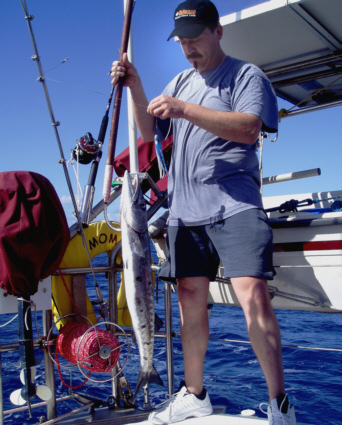
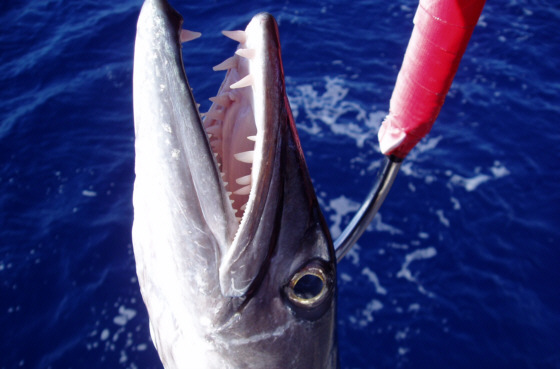
Hoping for a delicious meal, we naturally cast our fishing line right away. The first bite did not take long to happen either. A medium-sized (approx. 80 cm long) barracuda was on the line. The barracuda is an always hungry predator and unfortunately dangerous for us. Not only because of its very large and sharp teeth, no, because of ciguatera. This is a life-threatening poison that originates from a small species of algae. These algae live in the tropical coral reefs and are eaten by small fish. These small fish in turn are eaten by larger ones and these, logically, in turn by even larger ones. Thus, the toxin is increasingly concentrated and the barracuda, at the end of this food chain, then has the dose that is fatal for us humans inside it. Ciguatoxin is heat-stable and therefore cannot be destroyed by boiling, frying, or grilling. Therefore, the rule of thumb in tropical countries is: The barracuda must be shorter than an arm's length.
With regret, but following reason, we released the first catch again and put the fishing line back into the water. Not even 15 minutes later, another bite. This time the fishing rod bent even more and the anticipation of a mahimahi (dolphinfish), or even a delicious wahoo, increased. Our disappointment was immense when the fish, after a minutes-long fight, was finally by the boat. Again a barracuda. This time even one with a length of over a metre. This time we, or rather the fish, had bad luck because the hook was already so deep in the throat that we could no longer get it out. This big fish also had to go overboard again because it certainly had many times the dose of ciguatoxin that is tolerable for us inside it. Now we waited about three hours before our bait, which we had meanwhile exchanged for a blue one, went back into the water. Unfortunately, the same thing happened again. Another barracuda (this time approx. 75 cm) on the line. Annoyed, we released this one too and put our fishing gear away. For dinner we just had chicken from the grill again.
Los Haitises National Park
This large national park, located in the south of the Bay of Samana, was our next stop. To be allowed to anchor there, however, a small permit must be obtained in advance. This would cost nothing, it was said by the commander during clearance.
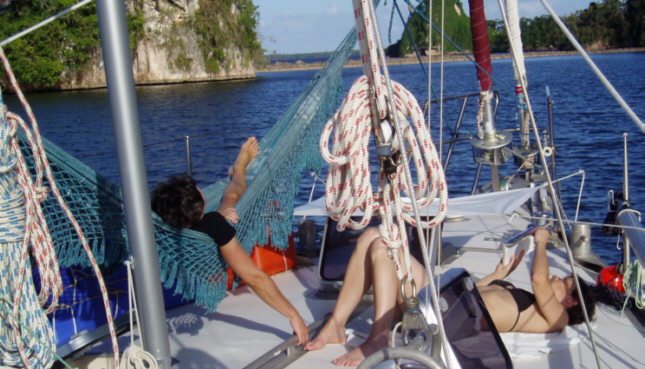
Towards the middle of the afternoon of 23 December, we visited the commander's office to get this very permit. "Oh disculpe, no permit can be issued today. The woman who operates the typewriter is unfortunately not here at the moment, but please come back tomorrow." The next day, just before eight, we were to be found in the same office again. Once again the woman was not present, but today a fat, dark man could suddenly apparently also handle the typewriter keys. He sat down with his legs apart behind the machine and began ...... to wait. To my insolent question why he was not starting to write the form, another answered, "today is a holiday and filling it out therefore costs 200.- pesos extra." So that was that. I politely but very firmly demanded to speak to the commander immediately. Of course he had just, coincidentally a minute ago, gone out. All right, not an unsolvable problem. "Samana is not big, please go get him. I will wait here." Less than five minutes later, the commander stood before me and tried to wiggle his way out. When he noticed that there was no donation-happy American, but a stubborn goat from Switzerland standing in front of him, he personally signed the form and handed it to me with a friendly smile. Inwardly I was slightly proud to have defied this corrupt office. I pulled out my wallet and, to the surprise of those present, placed 200.-- pesos on the table. This episode was well worth the scant 10.-- Swiss francs to me, as a tip or even as a Christmas present to the office.
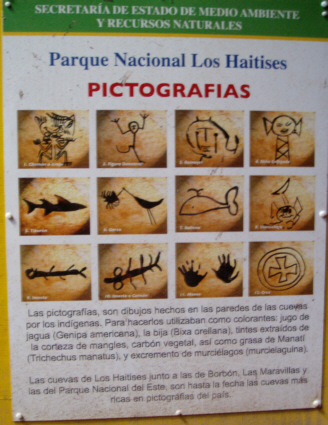
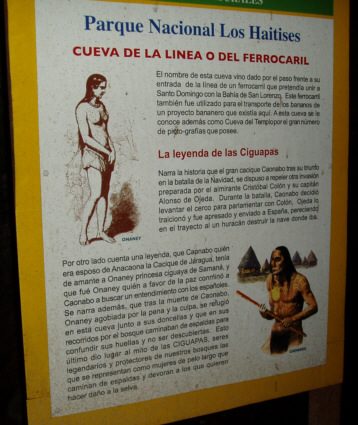
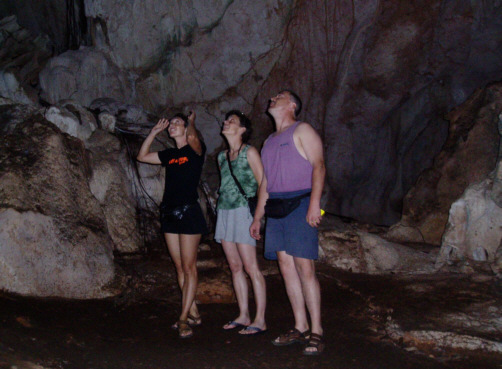
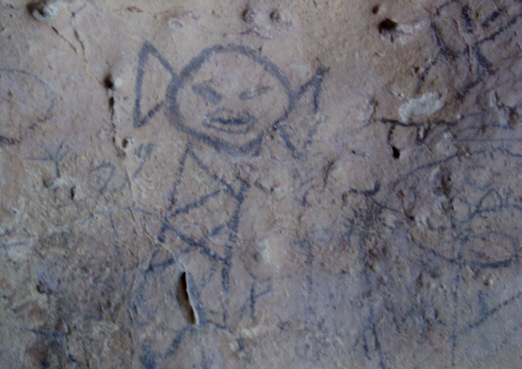
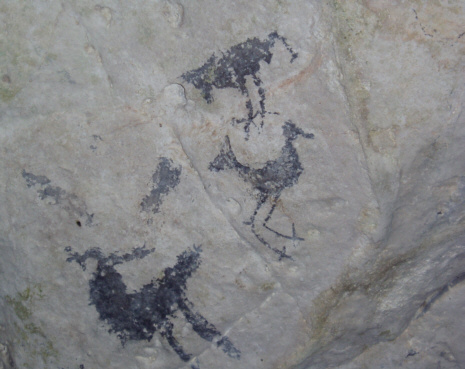
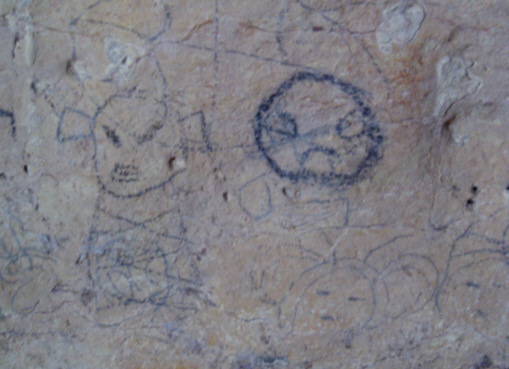
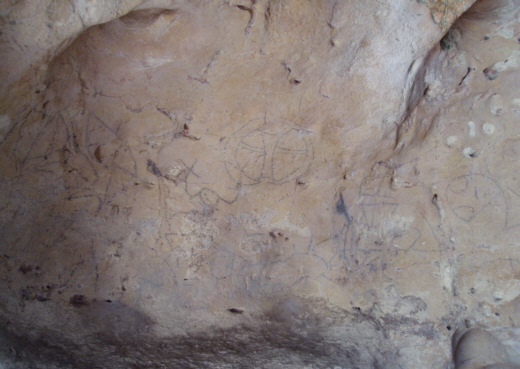
Arriving in the national park, we were greeted personally by the sergeant stationed there and his companion. Which was actually not particularly surprising, as the two MOMOs were once again the only sailboats on site. Only a few speedboats, filled with hotel tourists, sometimes came over from Samana or Sanchez. However, the stay of these boats never lasted longer than half an hour, then peaceful quiet returned. On this stretch of coast there were various caves that had been inhabited by the indigenous people. Many cave paintings by them have been preserved. But I had trouble with the motifs and symbols still visible today. Rather, as an absolute layman regarding Native Americans, they reminded me of the bedroom walls of my two sons Simon and Dani.
Trip to the "El Limon" Waterfall
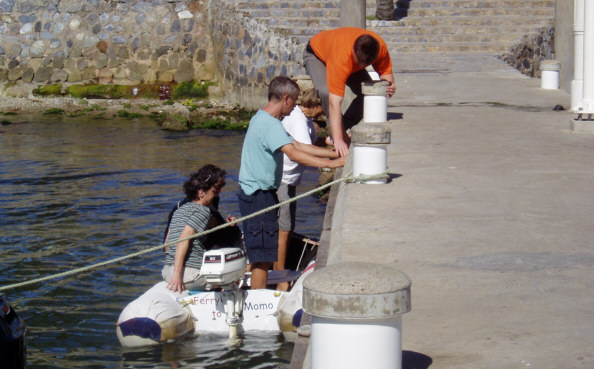
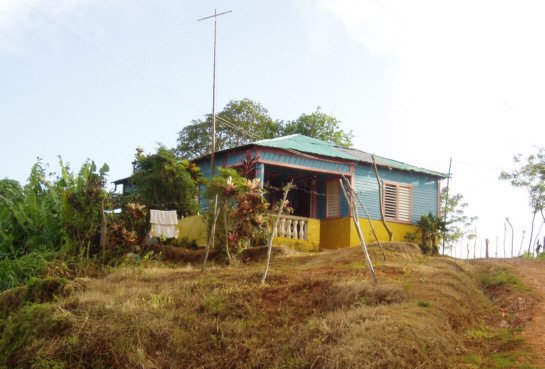
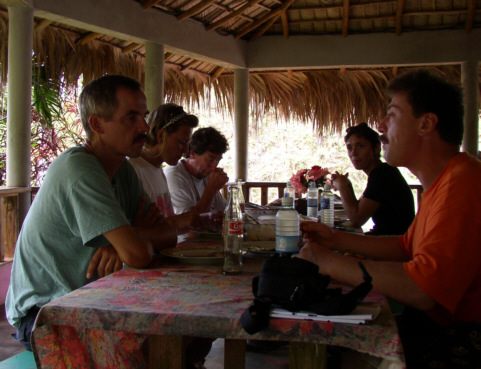
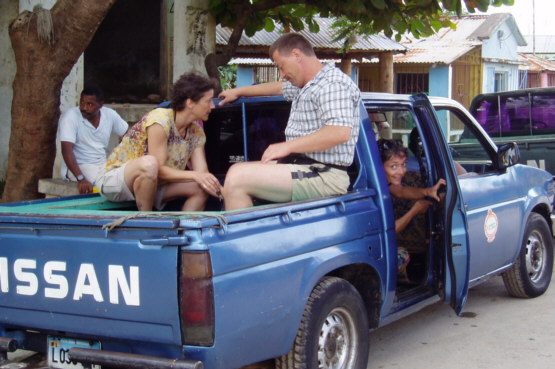
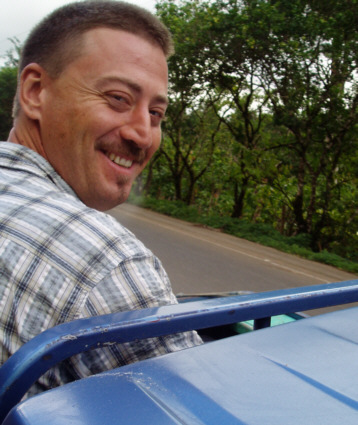
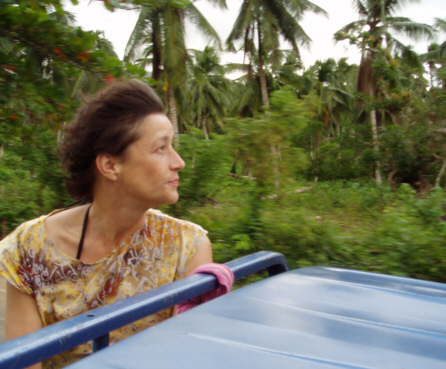
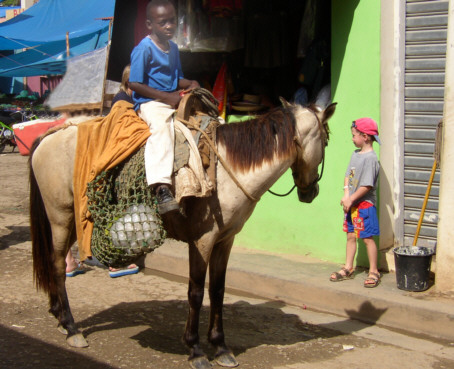
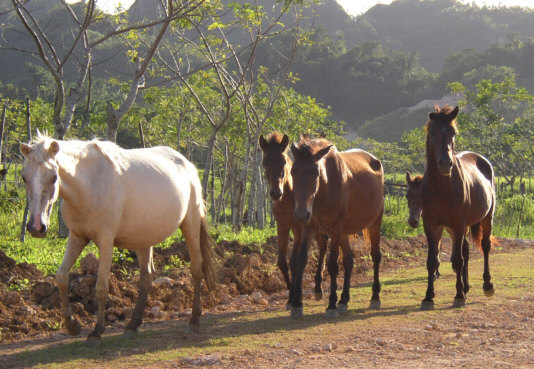
El Limon, the most famous waterfall in the north of the island, was said to be a must, people said from all sides. Coming from the West Indies, however, I was slightly skeptical about what Caribbean waterfalls had to offer. Until then, I had only ever seen small trickles that didn't really deserve the name waterfall. Full of expectations, we took the guagua towards El Limon. A guagua here was a kind of shared taxi and by far the cheapest way to get somewhere. Not only because of the cramped conditions in the constantly overcrowded cars, contacts with the locals were made immediately every time. Sometimes the cars only had small cabins and some of the people had to sit outside in the back on the loading bed. So too this time. Pascal visibly enjoyed feeling the wind whistling around his ears, while Caroline held on rather tenaciously to the roof structure. The last stretch to the waterfall was covered on the backs of comfortably walking horses. Then finally the waterfall. This thundered down over a roughly 35 m high rock face, and what is more, with a great deal of water. Below there was a small lake that invited you to swim. So I immediately take back my negative words. There really is a waterfall in the Caribbean.
Santa Barbara and its Vibrant Market
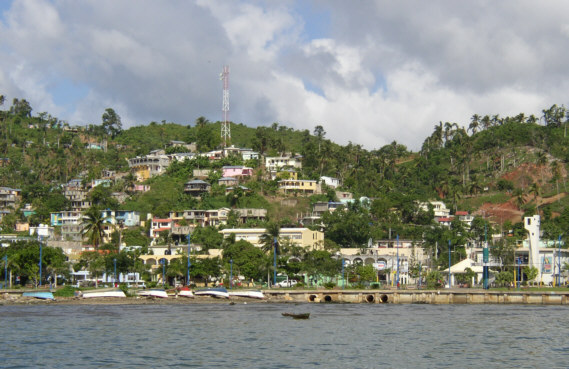
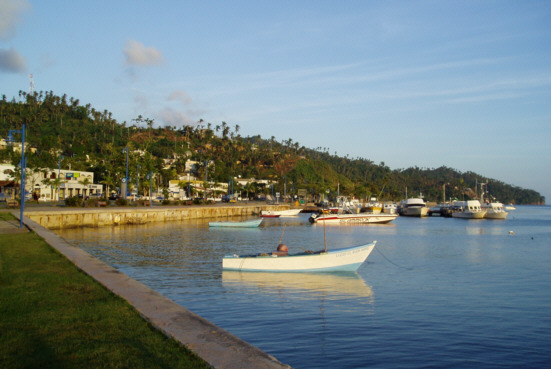
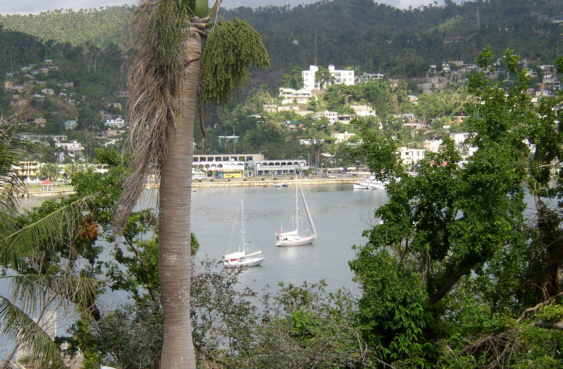
Santa Barbara is a small town on the north side of the bay. Without visible industry and without the large resort hotels, it looks rather sleepy here. Tourists actually only come here for the day to immediately head further out to the small bathing island of Cayo Leventado. That is supposedly where the tropical promotional film for "Bacardi" was filmed.
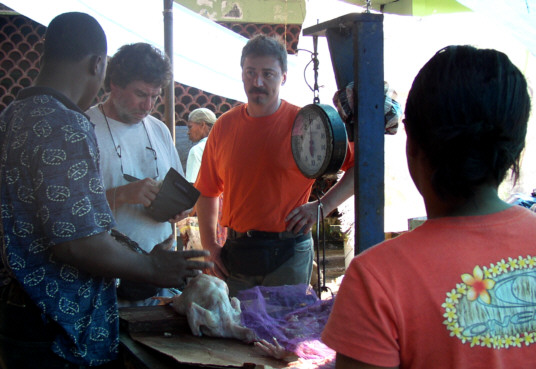
For me, the nicest thing about Santa Barbara is the name and the simple market. But this is truly unique and just bursting with life. I could linger there for hours just watching the hustle and bustle. The oranges were brought in by small trucks and partly sold right from the bridge. An old man came with his donkey and tried to sell some grapefruits to the women. Half an ox was being sawed up on a wooden board here, and over there the fish were, at least still in a plastic container, on ice. On another table, on the other hand, slaughtered chickens were ready and underneath the live replenishment was still cackling. There were piles of papayas, bananas, pineapples and here a pile of fresh vegetables. A truly colorful hustle and bustle, accompanied by loud merengue music. Merengue, as is well known, is the musical style of the Dominican Republic. To my ear, however, this was somewhat monotonous and therefore practically everything always sounded the same. With our MOMO we were anchored about 200 m away from the shore. Always in the late afternoon, the various small bars and snack bars started turning up their loudspeakers. We had the impression that the fewer people in the bar, the louder the music got. The mix of at least ten music sources that we sometimes had to endure was at times close to unbearable.